Management reports that build themselves: how to automate your reporting

Get the free report time check
The worksheet from this guide as a printable PDF: list every report your business makes, what each one costs in hours a year and who reads it, then pick the one to hand over first. Subscribe to our automation briefing and it downloads instantly.
Free, no strings. We only email about automation that could pay for itself, and you can unsubscribe with one click.
In one sentence: Automated reporting means your weekly and monthly management reports build themselves from the systems you already use and arrive on time, so nobody spends Monday morning copying numbers into a spreadsheet.
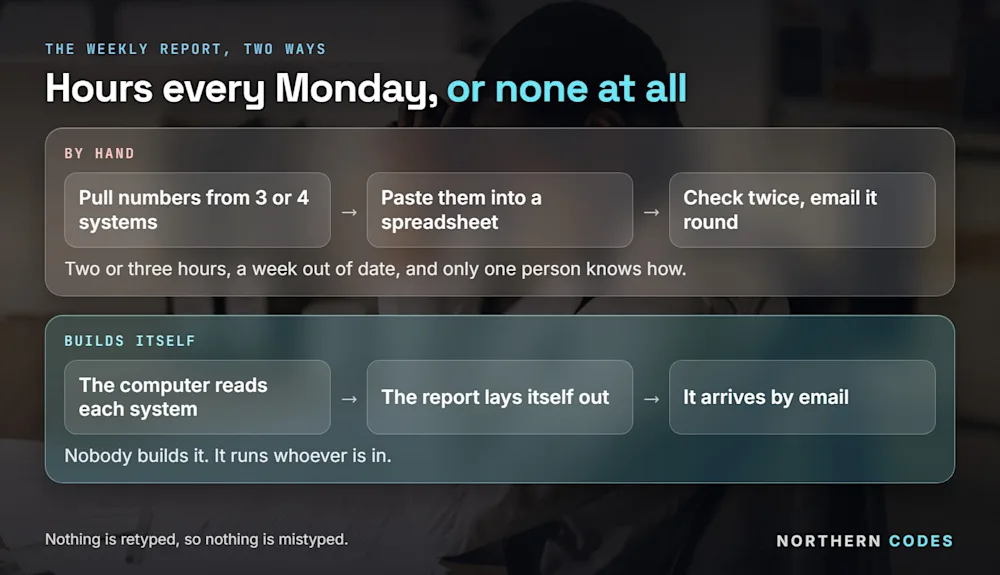
You'll know the scene. Someone spends Friday afternoon, or all of Monday morning, pulling numbers out of the accounts, the online shop and the stock system. They paste them into a spreadsheet, check them twice and email it round. By the time you read it, it's already a week old. Every week.
A computer can do that gathering for you every single week, pulling the same numbers from the same places in the same order, without anyone having to ask. This guide covers what goes in a management report, which reports can build themselves, what always needs a person, and how to start. It's one of the jobs we cover in our guide to automating business processes.
At a glance:
The job | The by-hand way | Built by itself |
|---|---|---|
The weekly sales report | Two or three hours pulling numbers from three or four places | Arrives by email, nobody builds it |
Monthly management accounts | The numbers are ready two or three weeks into the next month | The numbers are gathered on day one, ready for your accountant to check |
Copying mistakes | A wrong paste, a missed row, a number counted twice | Nothing is retyped, so nothing is mistyped |
When someone's off | Only one person knows how to build it | It runs whoever is in |
What is a management report?
A management report is the set of numbers you use to run the business: sales, cash, what you're owed, what you owe and how the month is going against plan. You choose what goes in it and how often it arrives. Weekly and monthly are the usual rhythm.
It's different from the accounts the law asks for. After the end of its financial year, a limited company must prepare full statutory annual accounts and a Company Tax Return. The accounts go to Companies House within 9 months (GOV.UK, checked 30-09-2026). They look back over a whole year, and they can arrive long after it ends.
Management reports are yours. Nobody asks for them, and that's the point: they tell you what's happening now, while you can still do something about it.
What goes in monthly management accounts?
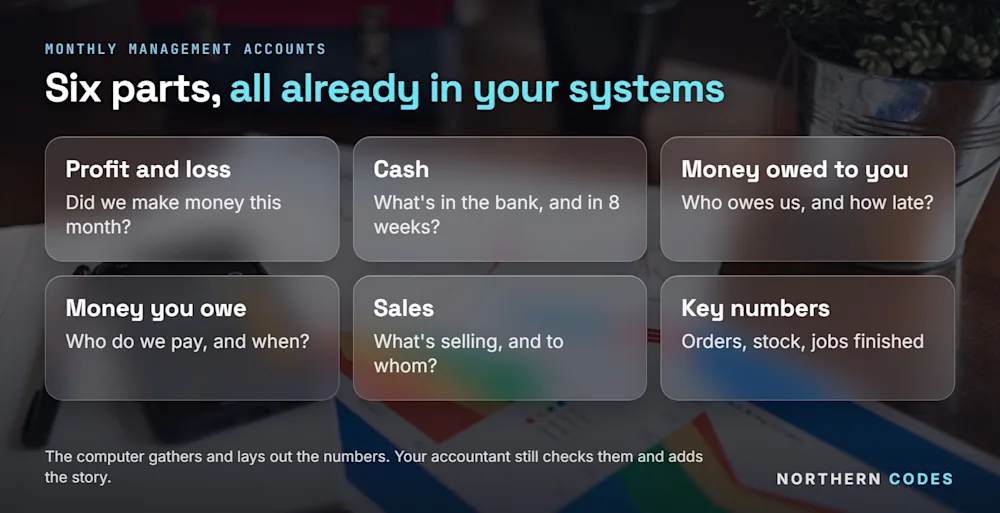
Monthly management accounts are the fuller version of the report, usually put together with your accountant. People search for them by that name, so here's what the pack normally holds, in plain words:
Part of the pack | What it tells you |
|---|---|
Profit and loss for the month | Did we make money this month, compared with plan and with last year? |
Cash | How much is in the bank, and how much there will be in eight weeks |
Money owed to you | Who owes you, how much, and how late they are |
Money you owe | Who you need to pay, and when |
Sales by customer or product | What's selling, and who's buying |
A few key numbers | Orders shipped, stock running low, jobs finished, whatever matters in your business |
Most of that already sits in your systems. The money is in the accounts software, the orders are in the online shop and the stock counts are in the stock system, so the pack only takes days because someone has to fetch each piece by hand and fit them together.
Why does building a report by hand take so long?
Because the numbers live in different places, and none of those places talk to each other. Every figure is found, copied, pasted and checked by a person. Then someone checks it again, because the last time a line went missing it caused an argument in the meeting.
There's a quieter problem too. One person usually knows the steps. When they're on holiday, the report is late or it doesn't come at all.
The law also asks a company to keep proper records of what it sells, buys, owes and is owed (GOV.UK, checked 30-09-2026). You're keeping those numbers anyway. A report that builds itself simply reads them where they already are.
Which reports can build themselves?
Almost any report that is the same shape every time. If you could write down the steps someone follows to make it, a computer can follow them too. These are the usual ones:
Report | Where the numbers come from | How often |
|---|---|---|
Sales report | Your online shop, your accounts software | Weekly |
Cash and money owed | Your bank account, your accounts software | Daily or weekly |
Monthly management accounts (the gathering and layout) | Your accounts software, your shop, your stock system | Monthly |
Stock report | Your stock system | Weekly |
Jobs and profit per job | Your job sheets, your timesheets, your invoices | Monthly |
Staff hours | Your timesheets or rota | Weekly |
Two things stay with people. The first is the story: why sales dipped, what the plan is now. The second is the accountant's check on the monthly pack. Automation gathers and lays out the numbers, so those people can spend their time on what the numbers mean.
If you'd rather have the numbers there whenever you look, that's a dashboard. We've written about the difference in our guide to business dashboards.
What does a report that builds itself look like?
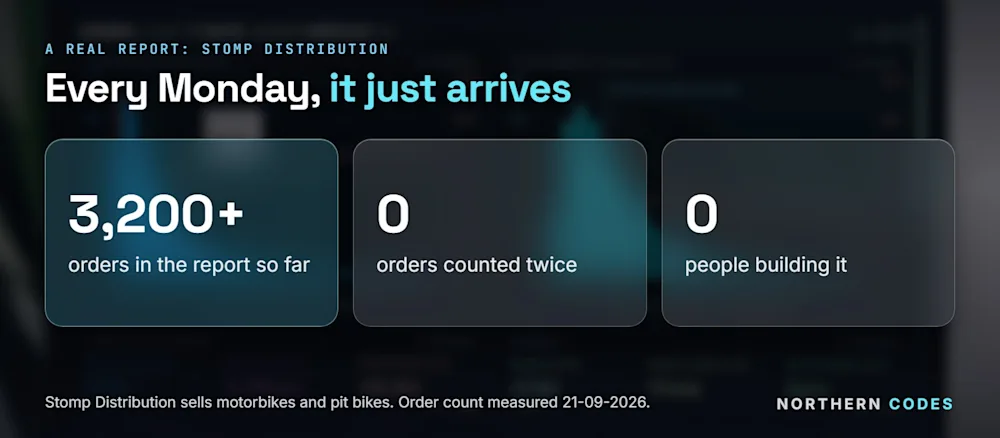
Here's a real one. Stomp Distribution sells motorbikes and pit bikes. Every Monday, a sales report makes itself and arrives by email. Before, one of their team built the same workbook by hand each week.
The report has covered over 3,200 orders so far, and not one of them has been counted twice (measured 21-09-2026). That second part matters. When a report is built by hand, a double-counted order is an easy mistake and a hard one to spot. When it builds itself, a check runs every time.
Nobody at Stomp has to remember it's Monday. The report just arrives.
How many hours does automated reporting give back?
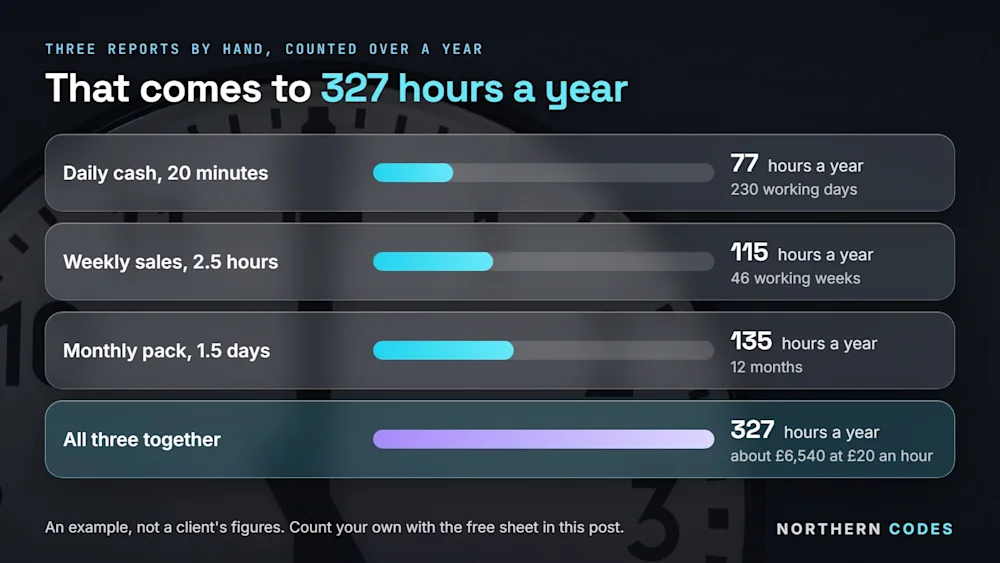
More than most owners guess, because the time is spread thinly: twenty minutes here, a morning there. Add it up over a year. It's a lot. Here's an example of three reports a business might build by hand.
Report | Time to build | How often | Hours a year |
|---|---|---|---|
Daily cash and money owed | 20 minutes | Every working day (230) | 77 |
Weekly sales report | 2.5 hours | Every week (46) | 115 |
Monthly management pack, the gathering part | 1.5 days (11.25 hours) | Every month (12) | 135 |
Total | 327 |
At £20 an hour in wages, 327 hours is about £6,540 a year. That's before counting the cost of a decision made on last week's numbers. Your own figures will differ; the free sheet below helps you count them.
How do you start?
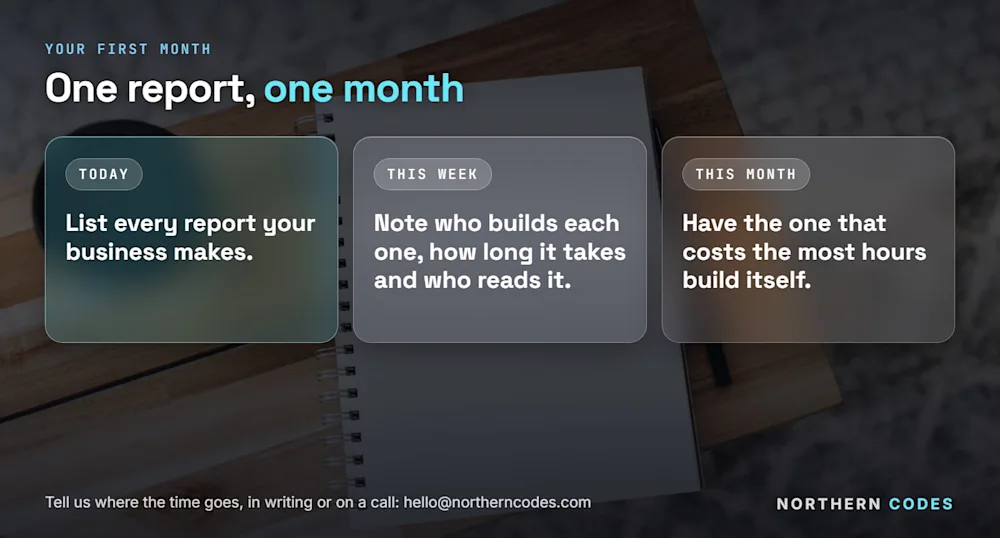
Pick one report and do it well. Three steps, over a month.
Today
List every report your business makes. Include the spreadsheet someone updates on a Friday that nobody calls a report.
This week
Next to each one, write who builds it, how long it takes, how often, where the numbers come from and who actually reads it. Some reports nobody reads. Stop those first. That costs nothing.
This month
Take the report that costs the most hours and is read the most, and have it build itself. Check the first few against the old way. Once the new one has matched the old one for a few weeks running and you trust it, move on to the next report on your list.
Tell us where the time goes
Tell us where the time goes, in writing or on a call. Either way, you get a plan and a fixed price. A short form or an email is enough.
Tell us in writing or book a call, whichever suits you. You can also email hello@northerncodes.com.
If you'd like to see the rest of what a computer can take off your team, our AI automation agency page walks through it.
Common questions
Can monthly management accounts be automated?
Yes, the gathering and the layout can. The numbers come straight from your accounts software, shop and stock system, and land in the same layout every month. Your accountant still checks them and adds the story.
Do I need new software to automate my reports?
No. The numbers come from the systems you already have. The work is linking them so the numbers arrive by themselves, then laying them out the way you like to read them.
Will an automated report be accurate?
Yes, and usually more accurate than one built by hand, because nothing is retyped. Checks can run every time too. Stomp's Monday report has covered over 3,200 orders without counting one twice.
Can the report come to me by email?
Yes. Most people prefer it that way. The report arrives at the same time every week, so nobody has to remember to build it or go and look for it.
What if a number looks wrong?
The report can flag it. If sales halve or a payment is very late, it says so at the top. You don't have to hunt for it in a table.
Will I know the price before you start?
Yes. You get a written plan and a fixed price before any work starts.
Sources: GOV.UK, Accounts and tax returns for private limited companies | GOV.UK, Running a limited company: company and accounting records. Both checked 30-09-2026.
Get the free report time check
The worksheet from this guide as a printable PDF: list every report your business makes, what each one costs in hours a year and who reads it, then pick the one to hand over first. Subscribe to our automation briefing and it downloads instantly.
Free, no strings. We only email about automation that could pay for itself, and you can unsubscribe with one click.