How Much Does AI Automation Cost for a UK Small Business?

Get the free AI automation budget planner
Turn this guide into your numbers: a printable planner with the current-state cost sheet, the ROI and payback calculation, a hidden-costs checklist and the budget-band decision page. Subscribe to our automation briefing and it downloads instantly.
Free, no strings. We only email about automation that could pay for itself, and you can unsubscribe with one click.
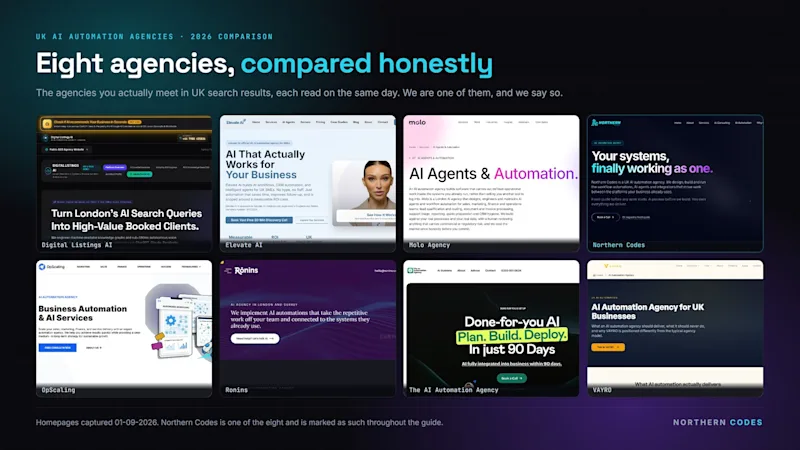
AI automation for a UK small business typically costs between 500 and 25,000 GBP depending on what you automate and whether you use off-the-shelf tools or commission a custom build. Most small businesses spending 1,500 to 4,000 GBP on a well-scoped automation project recover that investment within 90 days through saved staff hours alone. According to the Federation of Small Businesses, UK SMEs that adopted AI tools in 2025 reported an average time saving of 12.5 hours per week on administrative tasks. This guide breaks down what drives the cost, what you actually get at each budget level, and how to tell whether a quote you have received is fair. Once you know the numbers, the next question is usually who to hire, so we compared eight UK agencies on what they actually publish in our honest agency shortlist.
The Quick Answer: How Much Does AI Automation Cost?
AI automation is the use of artificial intelligence to handle repetitive business tasks without manual intervention - from sorting emails and generating invoices to managing customer follow-ups and syncing data between systems. Here is what UK small businesses typically pay across three tiers.
Budget tier | What you get | Typical cost | Best for
DIY tools only (Zapier, Make, n8n) | Simple rule-based automations connecting 2-3 apps | 50-150 GBP/month | Solo operators or very small teams with basic needs
Agency setup, standard workflows | Professional automation of 3-5 business processes with testing and handover | 1,500-5,000 GBP one-off + 200-500 GBP/month | Teams of 3-15 who want reliable automations but lack in-house technical skills
Custom AI agent build | Bespoke AI system with decision-making, natural language processing, and deep integration across all business systems | 5,000-25,000 GBP project | Businesses with complex workflows, high-volume processes, or industry-specific requirements
The vast majority of UK small businesses fall into the middle tier. A well-planned automation project costing 2,000 to 4,000 GBP typically saves 10-20 hours of staff time per week - and that math speaks for itself.
What Drives the Cost of AI Automation?
Not all automation projects cost the same. Here are the five factors that move the price up or down.
1. Number of systems being connected. Linking your email to a spreadsheet is simple. Connecting your CRM to your accounting software, website, email marketing platform, and customer support system in a single workflow is significantly more complex. Each additional system adds integration work.
2. Rules-based vs AI decision-making. A rules-based automation follows if/then logic - "if a new order arrives, create an invoice." An AI-powered automation makes judgement calls - "read this customer email, determine the intent, draft an appropriate response, and flag urgent requests." The second type costs more because it requires training, testing, and refinement.
3. Data volume and complexity. Automating 50 transactions a day is straightforward. Automating 5,000 with variations, exceptions, and edge cases requires more robust architecture and testing.
4. Bespoke development vs platform configuration. Using Make or Zapier to connect existing apps is faster and cheaper than building a custom integration from scratch. But platform-based solutions hit limits when your workflow does not fit their templates.
5. GDPR compliance requirements. Any automation that handles personal data in the UK must comply with UK GDPR. This adds cost for data handling, consent management, and audit logging - but it is non-negotiable.
What Do You Get at Each Budget Level?

Under 2,000 GBP: Quick Wins
At this level, you are paying for targeted automations that solve specific pain points. Expect to automate 2-3 workflows using platforms like Make, Zapier, or n8n.
Realistic outcomes: Automatic invoice generation when a job is marked complete. New enquiry notifications sent to Slack or Teams. Customer data synced between your website forms and CRM. Email follow-up sequences triggered by specific actions.
What is not realistic: Full AI chatbots, complex multi-system integrations, or anything requiring custom code at this price point.
2,000 to 8,000 GBP: The Sweet Spot for Most UK SMEs
This is where most small businesses get the best return. You are paying for a professional to analyse your workflows, design automations that fit your actual processes, build and test them, and hand over a documented system.
Realistic outcomes: End-to-end workflow automation across 4-6 business processes. AI-powered email triage and response drafting. Automated reporting that pulls data from multiple systems. Customer onboarding sequences with personalised communication. Integration between your CRM, accounting software, and communication tools.
At Northern Codes, most of our UK small business projects fall in this range. We focus on automations that save measurable hours per week rather than impressive demos that gather dust.
8,000 GBP and Above: Complex or Enterprise-Scale
This tier covers multi-system builds where AI is making decisions, not just following rules. Think custom AI agents that handle customer service, automated product listing systems, or complete business process overhauls.
Examples we have built: We automated product listings from Sage to WordPress for an e-commerce business, eliminating hours of manual data entry across their entire product catalogue. We also built a complete booking and customer management system for a Bromley restaurant that saved the owner over 20 hours a week.
Real UK Examples: The ROI Calculation

Numbers matter more than promises. Here is how the maths works for two real projects.
Example 1: Bromley Restaurant - 20+ Hours Saved Per Week
The problem: A restaurant owner was spending 20+ hours every week on bookings, customer communications, and admin tasks that could be automated.
The investment: A custom AI-powered booking and management system.
The return: At an estimated staff cost of 15 GBP/hour, saving 20 hours per week equals 15,600 GBP per year in reclaimed time. The project cost was recovered within 60 days. Read the full case study here.
Example 2: E-Commerce Product Sync - Manual Listing Eliminated
The problem: An e-commerce business was manually copying product data from Sage accounting software to their WordPress website - a tedious, error-prone process that consumed hours every week.
The investment: A custom automation that syncs product data directly from Sage to WooCommerce.
The return: Complete elimination of manual product listing work, zero data entry errors, and products going live on the website within minutes of being added to Sage. Full details in the Sage-WordPress case study.
The Simple ROI Formula
Here is how to calculate whether automation makes sense for your business:
(Hours saved per week x hourly staff cost x 52) - annual automation cost = net yearly gain
For example: saving 15 hours per week at 18 GBP/hour with an automation costing 3,000 GBP one-off and 300 GBP/month:
Saving: 15 x 18 x 52 = 14,040 GBP/year
Cost: 3,000 + (300 x 12) = 6,600 GBP in year one
Net gain year one: 7,440 GBP. Year two onwards: 10,440 GBP/year.
If your calculation shows a positive return within 12 months, automation is almost certainly worth it.
Hidden Costs to Watch For
Honest pricing means flagging the costs that other agencies gloss over.
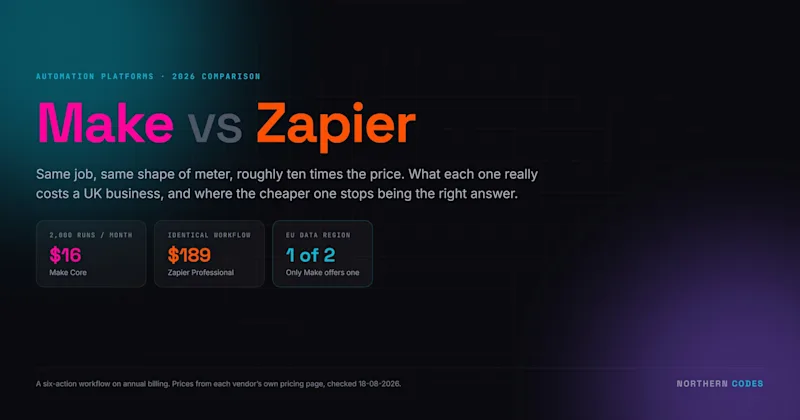
Platform fees at scale. Zapier and Make charge based on the number of tasks (actions) your automations run. A workflow that processes 100 tasks a day might cost 30 GBP/month today, but 150 GBP/month when your business grows. Ask about per-task pricing before committing to a platform.
API rate limits and charges. Some third-party services charge for API access or impose rate limits that affect automation speed. Your accounting software, CRM, or email provider may have API tiers that cost extra.
Maintenance when business processes change. Automations are not set-and-forget forever. When you add a new product line, change your invoicing process, or switch accounting software, automations need updating. Budget 200-500 GBP/month for ongoing maintenance, or negotiate it into your initial contract.
Staff time during setup. Even with a specialist handling the build, your team will spend time explaining processes, testing workflows, and providing feedback during development. Plan for 2-5 hours per week during the project.
Integration dependencies. If a third-party app changes its API (and they do), your automations may break. A good automation partner monitors for these changes and fixes them proactively - check whether this is included in ongoing support.
How Do I Choose the Right Automation Partner?
Not all automation agencies deliver the same value. Here is what to look for when evaluating quotes.
They start with your processes, not their tools. A good partner asks about your workflows before recommending technology. If someone pitches a specific platform before understanding your business, that is a red flag.
They give specific time-saving estimates. Vague promises of "increased efficiency" mean nothing. Ask for projected hours saved per week and the methodology behind that estimate.
They explain ongoing costs clearly. No hidden fees, no surprise monthly charges after the project. The total cost of ownership should be clear from the start.
They have UK case studies with measurable results. Theory is cheap. Ask for evidence of real projects with quantified outcomes - hours saved, costs reduced, processes automated. As we explained in our guide to AI agents, the difference between hype and results comes down to implementation.
They offer a phased approach. Anyone who wants to automate everything at once is either inexperienced or padding the quote. The best results come from starting with your biggest pain point, proving ROI, then expanding.
Hold us to the same list. Our AI automation agency page sets out how we scope a build, the fixed quote you see before any work starts, and what you own when it is handed over.
FAQ: AI Automation Cost Questions Answered
Q: How much does AI automation cost for a small business in the UK? AI automation for UK small businesses typically costs between 500 and 25,000 GBP depending on scope. Most SMEs invest 2,000 to 5,000 GBP for professional automation of 3-5 business processes, with ongoing costs of 200-500 GBP per month for maintenance and platform fees.
Q: Is AI automation worth it for small businesses? Yes, for most businesses handling more than 10 hours per week of repetitive tasks. A typical automation project pays for itself within 3-6 months through staff time savings alone. The Federation of Small Businesses reports UK SMEs save an average of 12.5 hours per week after adopting AI tools.
Q: Can I automate my business without a developer? Yes, for simple workflows. Platforms like Make, Zapier, and n8n let you connect apps without code. But for multi-system integrations, AI-powered decisions, or complex business logic, a specialist typically saves more than their fee by building reliable automations faster.
Q: How long does AI automation take to pay for itself? Most UK small business automation projects break even within 60-120 days. The payback period depends on how many hours you save and your staff costs. Use the formula: (weekly hours saved x hourly cost x 52) divided by annual automation cost.
Q: Do I need to pay monthly for AI automation? It depends on the approach. Platform-based automations (Zapier, Make) require monthly subscriptions that scale with usage. Custom-built automations hosted on your own infrastructure have lower ongoing costs - typically 50-100 GBP/month for hosting only.
The Bottom Line
AI automation is not a luxury for big businesses with big budgets. A UK small business spending 2,000 to 5,000 GBP on a well-planned automation project can realistically save 10-20 hours of staff time per week - and recover the investment within 90 days. The key is starting with your biggest time sink, proving the ROI, and expanding from there.
The smartest first step is a conversation, not a commitment. Get in touch for a free consultation and we will identify exactly where automation would save you the most time and money - with honest numbers, not sales promises.
Ready to find out what automation could save your business? Request a free quote or explore our automation services.
---
Sources: [Federation of Small Businesses - UK SME AI Adoption 2025](https://www.fsb.org.uk) | [Make Pricing](https://www.make.com/en/pricing) | [Zapier UK Pricing 2026](https://zapier.com/pricing) | [UK GDPR Guidance - ICO](https://ico.org.uk/for-organisations/uk-gdpr-guidance-and-resources/) | [Nucleus Research - Automation ROI](https://nucleusresearch.com)
Related reading: how automating invoicing saved one UK business about 22 hours a week.
Get the free AI automation budget planner
Turn this guide into your numbers: a printable planner with the current-state cost sheet, the ROI and payback calculation, a hidden-costs checklist and the budget-band decision page. Subscribe to our automation briefing and it downloads instantly.
Free, no strings. We only email about automation that could pay for itself, and you can unsubscribe with one click.