Make vs Zapier: Which Should Your UK Business Use in 2026?
Get the free Make vs Zapier cost estimator
Do the sum on your own workflows: count your action steps and runs, apply each platform’s meter including what it charges nothing for, then read your tier and monthly price straight off both ladders. Subscribe to our automation briefing and it downloads instantly.
Free, no strings. We only email about automation that could pay for itself, and you can unsubscribe with one click.
In one sentence: Zapier is the easier and better connected of the two, with 9,000+ apps and a builder a non-technical person can learn in an afternoon, while Make does the same work for roughly a tenth of the price at moderate volume and is the only one of the two that will keep your data in an EU data centre, which makes Zapier the safer default for small, simple, occasional workflows and Make the obvious choice once volume, branching logic or UK data rules enter the picture.
Make and Zapier are the two automation platforms most UK small businesses actually choose between. Both connect your apps, both are drag-and-drop, both run in someone else's cloud so there is no server to look after. We build on both at Northern Codes and we sell neither, so this is the honest version: what each charges in 2026, which costs are hidden until the invoice arrives, and the point where one clearly beats the other. It sits under our three-way comparison, n8n vs Zapier vs Make, and pairs with n8n vs Zapier if self-hosting is on your list. If you would rather we mapped your workflows to the right platform and built them, book a strategy call.
Make vs Zapier at a glance
Zapier | Make | |
|---|---|---|
How it bills | Per task: every action step that runs | Per credit: every module action that runs |
Does the trigger cost anything? | No, triggers and polling are free | Yes, the trigger module is one credit |
Free tier | 100 tasks/month, two-step Zaps only | 1,000 credits/month, maximum 2 active scenarios |
Cheapest paid | $19.99/mo annual (750 tasks) | $9/mo annual (10,000 credits) |
Integrations | 9,000+ apps | 3,000+ apps |
Branching and loops | Filters and Paths, both free | Routers and filters, both free |
EU data hosting | No, US only | Yes, chosen when you create the organisation |
AI agents | Zapier Agents, a separate product with its own billing | Built into the plans, using Make's AI provider or your own key |
Best for | Fast setup, niche apps, non-technical teams | Volume, visual logic, UK and EU data rules |
Prices from each vendor's official pricing page, checked 18-08-2026, annual billing, in USD. Both bill in US dollars, so exchange rate and VAT hit each of them the same way.
What is the real difference between Make and Zapier?
Both charge for every step your workflow runs, so the meters are the same shape. What separates them is the price per unit and what falls outside the count. Make charges one credit for every module action, including the trigger. Zapier counts one task for every action step and lets the trigger run free. Make then sells those units at roughly a tenth of Zapier’s price, which is where the whole cost gap comes from.
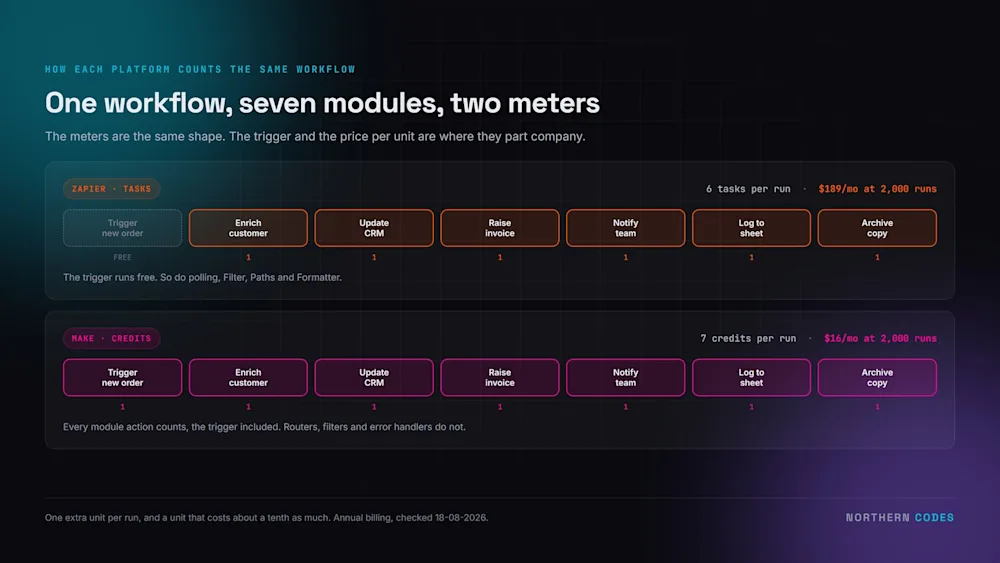
That single fact surprises people who have read the older comparisons, which tend to frame this as Zapier’s per-task model against a cheaper per-operation model. The models are close cousins. The prices are not.
How much does each cost in 2026?
Treat every headline as a floor. On both platforms your plan is a feature level plus a usage tier, and the usage tier is what moves.
Zapier pricing
- Free: $0, 100 tasks per month, two-step Zaps only, one seat.
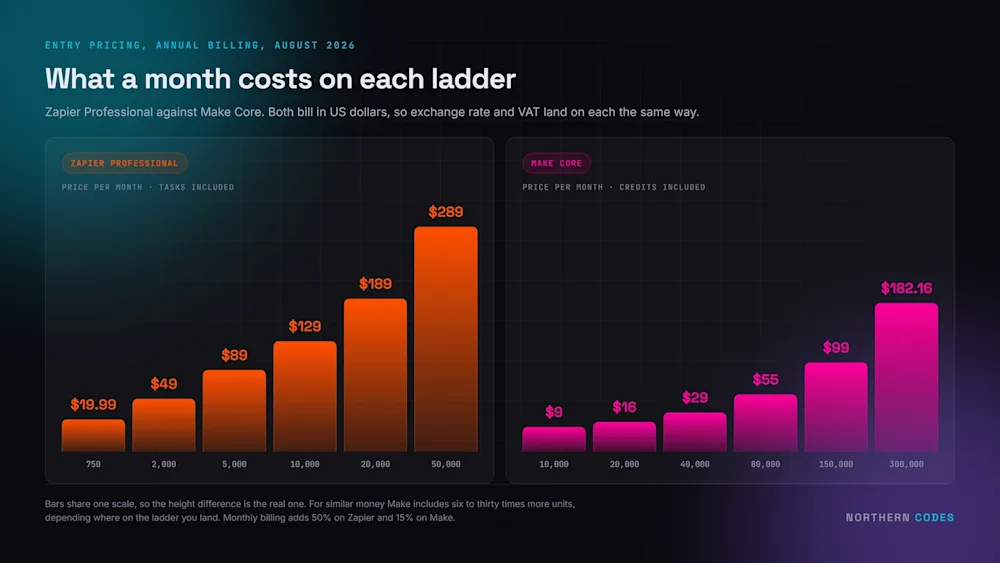
- Professional: from $19.99/month billed annually for 750 tasks, then $49 for 2,000, $89 for 5,000, $129 for 10,000, $189 for 20,000, $289 for 50,000 and $489 for 100,000.
- Team: from $69/month billed annually for 2,000 tasks, rising the same way, with 25 seats and SAML single sign-on.
Monthly billing costs 50% more than annual across the board. Triggers, polling, Filter, Paths and Formatter do not consume tasks, which genuinely helps workflows that check often and act rarely. Current figures on Zapier’s pricing page.
Make pricing
- Free: $0, 1,000 credits per month, but only 2 active scenarios and a 15-minute minimum gap between scheduled runs.
- Core: $9/month billed annually for 10,000 credits, then $16 for 20,000, $29 for 40,000, $55 for 80,000 and $99 for 150,000. Unlimited active scenarios and scheduling down to the minute.
- Pro: $16/month billed annually at 10,000 credits, for priority execution, custom variables and full-text log search.
- Teams: $29/month billed annually at 10,000 credits, adding team roles and shared templates.
Monthly billing is about 15% more: Core is $10.59, Pro $18.82, Teams $34.12. Current figures on Make’s pricing page.
What does the same workload actually cost on each?
Here is one ordinary workflow: an order arrives, you enrich the customer record, update the CRM, raise the invoice, notify the team and log it. Six actions. On Zapier that is 6 tasks per run because the trigger is free. On Make it is 7 credits per run because the trigger counts. Priced on annual billing at August 2026 rates:
Runs per month | Zapier tasks | Zapier cost | Make credits | Make cost |
|---|---|---|---|---|
100 | 600 | $19.99 (750 tier) | 700 | $0 on Free, or $9 Core |
500 | 3,000 | $89 (5,000 tier) | 3,500 | $9 (10,000 tier) |
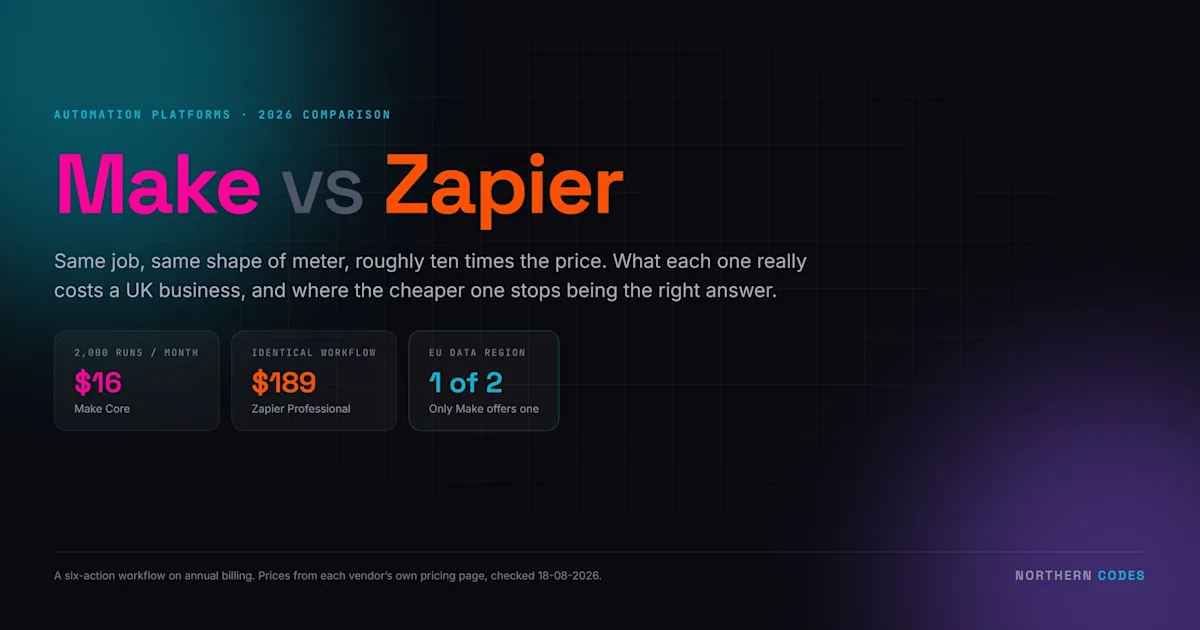
2,000 | 12,000 | $189 (20,000 tier) | 14,000 | $16 (20,000 tier) |
10,000 | 60,000 | $489 (100,000 tier) | 70,000 | $55 (80,000 tier) |
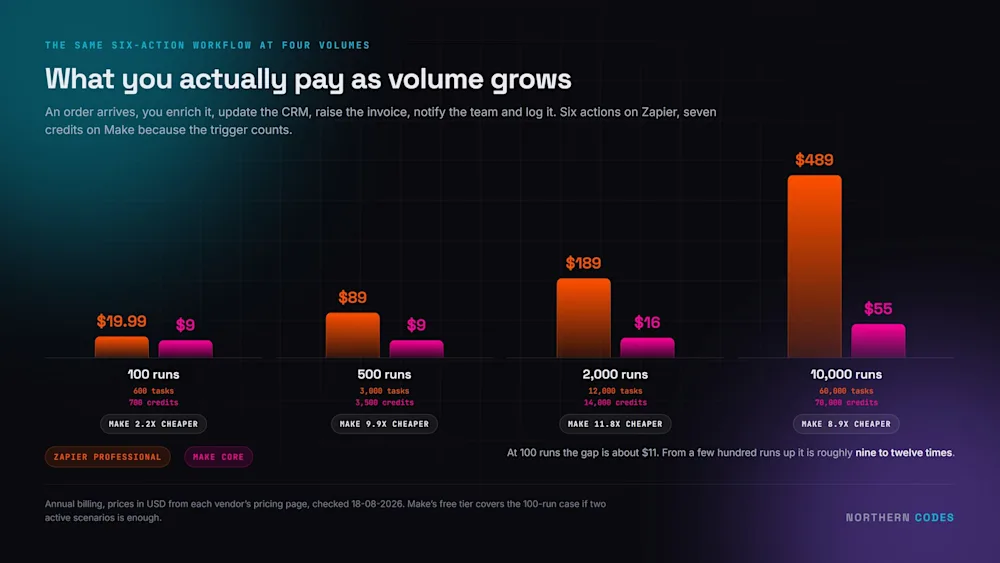
At a hundred runs a month the gap is about $11 and you should pick on ease of use rather than price. From a few hundred runs upward Make costs roughly a ninth to a twelfth of Zapier for identical work, and the gap holds all the way up. Look at the free tiers the same way: Zapier’s 100 tasks buy you about 16 runs of that workflow, Make’s 1,000 credits buy about 142.
The number that decides this for you is your own step count multiplied by your own volume, which is a different sum from the headline price. Our AI automation cost guide works through the wider budget, and the free estimator on this page does this sum for both platforms.
What actually drives the bill on each?
This is where the invoices surprise people, and it is the part the pricing pages bury.
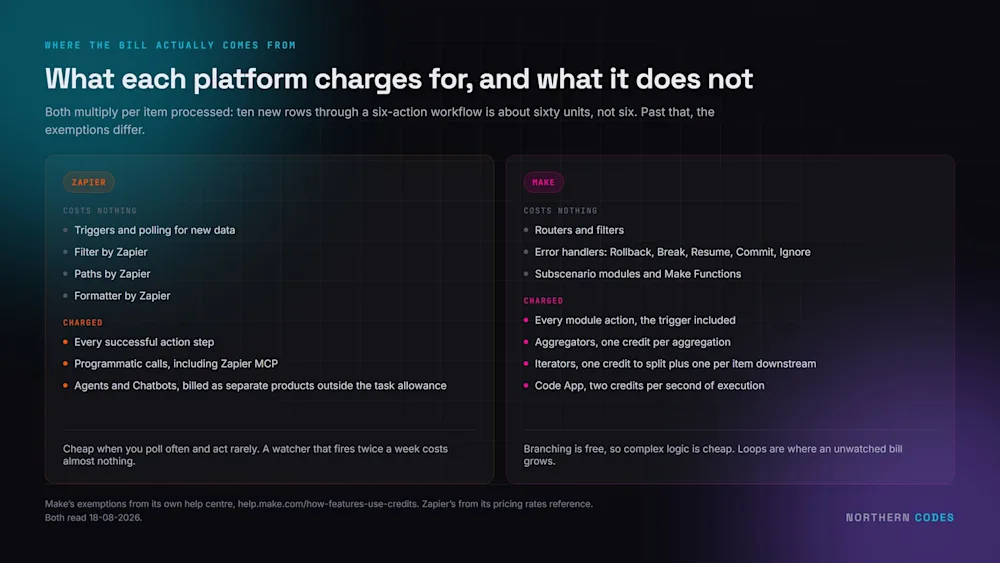
Both platforms multiply per item. If a trigger finds 10 new rows, Zapier starts 10 separate Zap runs and Make runs every downstream module 10 times. Ten items through a six-action workflow is roughly 60 tasks or 60 credits, not 6. Nearly every "why is my bill so high" question traces back to this.
Free on Zapier: triggers, polling for new data, and the built-in tools Filter, Paths and Formatter. A Zap that polls every five minutes and acts twice a week is close to free, which is a real Zapier advantage.
Free on Make: routers and filters, the error handlers (Rollback, Break, Resume, Commit, Ignore), the subscenario modules, and Make Functions. Branching costs nothing, which is why complex logic is cheap here.
Expensive on Make, and easy to miss: an aggregator costs one credit per aggregation, an iterator costs one credit to split plus one credit for every item it produces downstream, and the Code App charges two credits for every second of execution time. Make documents this properly in how features use credits, and it is worth reading before you design anything with loops in it.
Which is easier to use?
Zapier, clearly. Its builder is a straight line, the template library is enormous, and someone with no technical background can get a working automation live the same day. Make gives you a canvas instead: modules, routers, iterators and error handlers wired together as a flowchart. It is more capable and it takes longer to learn. Our honest rule is that Make repays about a week of getting comfortable, and if nobody has that week, Zapier is the right answer regardless of the price gap.
Which connects to more apps?
Zapier, by roughly three to one: 9,000+ apps against Make’s 3,000+. If your stack includes niche or older UK software, Zapier is far more likely to support it out of the box. Both include a generic HTTP request module, so anything with an API can be wired up either way with more work, which is a project in itself and one we cover in our systems integration guide.
Which is better for AI and agents?
Make, on the current pricing. Its AI agents, the Maia conversational builder, the MCP server and 350+ AI apps sit inside the normal plans, and you can point them at Make’s AI provider or bring your own model key. Zapier’s Agents and Chatbots are separate products with their own billing units, outside the task economy, so an agent experiment that works turns into a second invoice. For what agents actually do for a small business, we wrote a plain guide to AI agents.
What about UK GDPR and data residency?
This is the sharpest practical difference between the two, and for some businesses it decides the question on its own.
Zapier stores and processes personal data in the United States. There is no EU or UK region to choose. That is workable under UK GDPR, and Zapier relies on the EU-US Data Privacy Framework with the UK Extension plus standard contractual clauses, which it sets out in its data transfer impact assessment. The accountability for that transfer still sits with you, as the ICO makes clear.
Make lets you choose a data centre region, US or EU, when you create the organisation. Pick EU and your scenario data is stored and processed there. One warning that matters more than it sounds: you cannot change the region afterwards, short of moving to an Enterprise plan, so the choice is made in the first two minutes of setup by whoever happens to be signing up. Make documents this in its organisations guide.
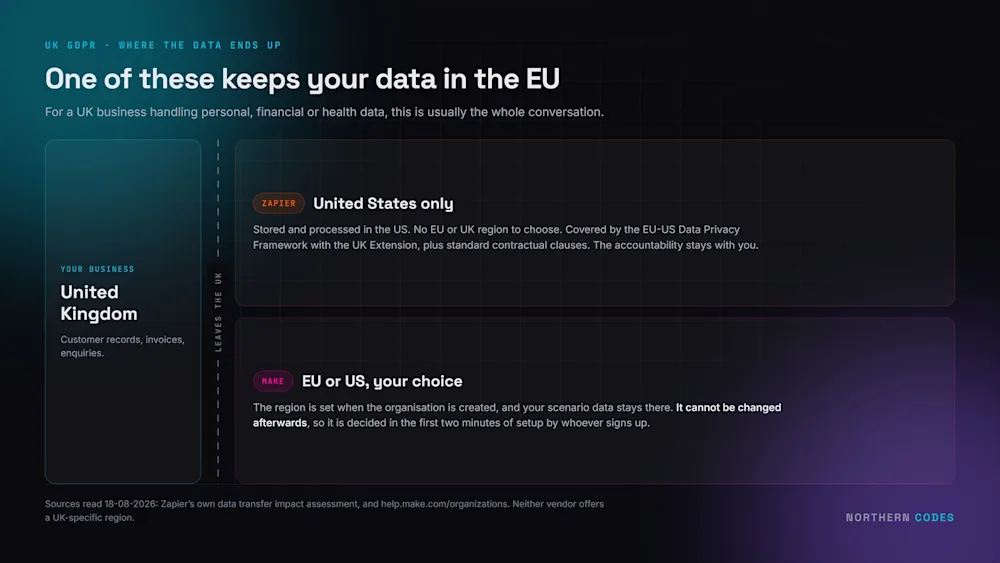
If you handle personal, financial or health data, that difference is usually the whole conversation. It is the same reasoning behind our piece on relying on US-hosted AI.
When should you choose Zapier?
Choose Zapier when the workflow is simple, the volume is low, and the apps are the point. If you run a few hundred tasks a month, need a connector to something obscure, or need the thing working before Friday with nobody technical in the building, Zapier earns its price. The free tier and the $19.99 plan cover a surprising amount of real small-business work, and a workflow that polls constantly but acts rarely is cheaper here than the headline suggests.
When should you choose Make?
Choose Make when volume, logic or data location matter. Past a few hundred runs a month the cost difference stops being academic and starts funding something else. Branching, routing and error handling are free and properly supported. AI agents are included rather than sold separately. And it is the only one of the two that will keep your data in the EU. The price is a steeper learning curve and a smaller app catalogue, both of which are survivable and neither of which shows up on an invoice.
Not sure which side you land on? We map your actual workflows, volumes and data constraints to the right platform, then build and run it. No vendor preference, no lock-in. Book a strategy call or get a quote.
Common questions
Is Make really ten times cheaper than Zapier?
At moderate volume, yes, for identical work. Our six-action workflow at 2,000 runs a month costs $189 on Zapier and $16 on Make, both on annual billing, both checked 18-08-2026. The gap narrows at very low volume, where Zapier’s free tier and $19.99 plan are perfectly reasonable, and it never reverses as you grow.
Is Make the same thing as Integromat?
Yes. Make is the rebranded Integromat, the same visual platform under a new name and the current credit-based pricing. Anything written about Integromat’s builder still broadly applies; anything written about its prices does not.
Can I keep my data in the UK with either platform?
Not exactly, on either. Make offers an EU data centre region, which is the closest option and satisfies most UK requirements, but it has no UK-specific region and the choice is locked once the organisation is created. Zapier is US-only. If your data genuinely has to stay on UK soil, neither cloud platform does it and you are looking at a self-hosted tool, which is the case we make in our n8n comparison.
Which is cheaper for a small business just starting out?
Make, on the free tier, provided two active scenarios is enough and a 15-minute gap between runs is acceptable. Its 1,000 free credits go roughly nine times further than Zapier’s 100 free tasks. Zapier’s free tier is really a trial; Make’s is usable for a genuine first automation.
Do I need to know how to code to use Make?
No. Make is drag-and-drop like Zapier, just with more pieces on the board. You will meet concepts Zapier hides from you, mainly how data flows between steps as bundles, and that is the actual learning curve rather than any code. Make does offer a Code App for JavaScript and Python if you want it, priced at two credits per second of execution.
Should I start on one and switch later?
You can, and plenty do, but nothing transfers automatically. A switch means rebuilding each workflow by hand, so the logic carries over and the build does not. The usual trigger points we see are a Zapier bill crossing about £100 a month, or a client question about where their data is stored. If either is coming, it is cheaper to start on Make. If you are weighing self-hosting too, start with what to automate first.
Get the free Make vs Zapier cost estimator
Do the sum on your own workflows: count your action steps and runs, apply each platform’s meter including what it charges nothing for, then read your tier and monthly price straight off both ladders. Subscribe to our automation briefing and it downloads instantly.
Free, no strings. We only email about automation that could pay for itself, and you can unsubscribe with one click.