Claude Opus 4.6 vs GPT-5.3 Codex: The AI Coding War Heats Up

Two AI Giants, One Week, Zero Coincidences
On February 4th, Anthropic dropped Claude Opus 4.6. Roughly 24 hours later, OpenAI countered with GPT-5.3 Codex. Coincidence? Not a chance.
This is the AI equivalent of two flagship phones launching the same week, and it tells you everything about how seriously both companies take the coding and automation space right now.
We've spent the past few days putting both models through their paces. Here's what we actually found, beyond the marketing hype.
What Claude Opus 4.6 Brings to the Table
Anthropic's latest feels like a genuine leap forward. The headline feature is that enormous 1 million token context window - currently in beta, but already usable. For perspective, that's roughly equivalent to feeding the AI an entire codebase of a mid-sized application in one go.
The Standout Features
Adaptive Thinking - Opus 4.6 can dynamically adjust how much reasoning it applies to a problem. Simple question? Quick answer. Complex debugging task? It'll take its time and think through the problem step by step. Developers can control this with four effort levels: low, medium, high, and max.
Agent Teams - This is genuinely new. You can now spin up multiple Claude agents that work in parallel, coordinate with each other, and tackle different parts of a problem simultaneously. Think of it like having a small team of AI developers rather than just one.
1M Token Context - Being able to hold an entire codebase in context means fewer 'sorry, I lost track of that file' moments. For large enterprise projects, this is a meaningful advantage.
Cybersecurity Prowess - Opus 4.6 has already uncovered over 500 zero-day vulnerabilities in open-source code. That's not a marketing number - it's a practical demonstration of what these models can do when pointed at real-world security challenges.
What GPT-5.3 Codex Delivers
OpenAI's response is characteristically different. Where Claude went deep on reasoning, Codex went wide on speed and interactivity.
The Standout Features
Interactive Steering - This is GPT-5.3's killer feature. You can redirect the model mid-task without losing context. It's like pair programming where you can tap your colleague on the shoulder and say 'actually, try this approach instead' without starting over.
25% Faster Inference - Speed matters in agentic workflows where the AI is running loops, making decisions, and calling tools repeatedly. A 25% improvement compounds quickly over extended sessions.
Self-Bootstrapping - GPT-5.3 helped build itself. OpenAI used early versions to debug training issues and manage its own deployment. It's a compelling demonstration of the model's capabilities, even if it does feel slightly unsettling.
Deep Diffs - Codex now shows patch rationale alongside its code changes, explaining why it made each modification. This makes code review substantially easier when you're working with AI-generated changes.
The Benchmarks: Who Actually Wins?
This is where things get interesting, and also where you need to be careful. Both companies report on slightly different benchmark variants, which makes direct comparison genuinely difficult. Here's what we can say with confidence:
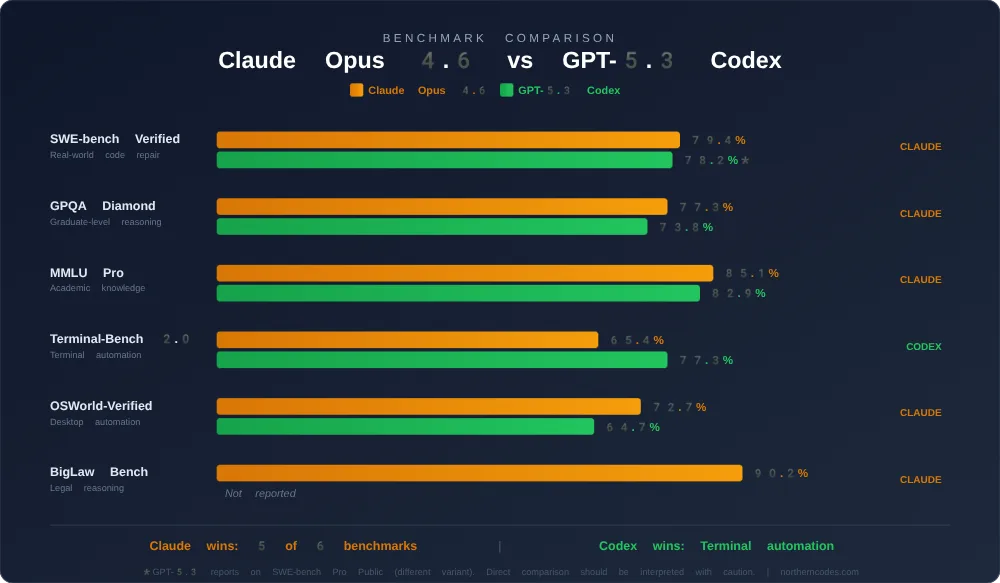
Claude Opus 4.6 leads in reasoning and knowledge tasks. On GPQA Diamond (graduate-level reasoning), Claude scores 77.3% versus Codex's 73.8%. On MMLU Pro (academic knowledge), it's 85.1% to 82.9%. And on BigLaw Bench for legal reasoning, Claude hits an impressive 90.2%.
GPT-5.3 Codex dominates terminal automation. On Terminal-Bench 2.0, Codex scores 77.3% compared to Claude's 65.4%. That's a significant gap, and if your workflow is heavily terminal-based, it matters.
Claude takes computer use and GUI navigation. On OSWorld-Verified, Claude scores 72.7% versus Codex's 64.7%. For desktop automation and visual understanding tasks, Anthropic has the edge.
The pattern is clear: Claude thinks deeper, Codex moves faster. Neither is universally better - they've optimised for different strengths.
Pricing and Access: Where Your Money Goes
This is where the decision gets more practical, and where the nuance really matters.
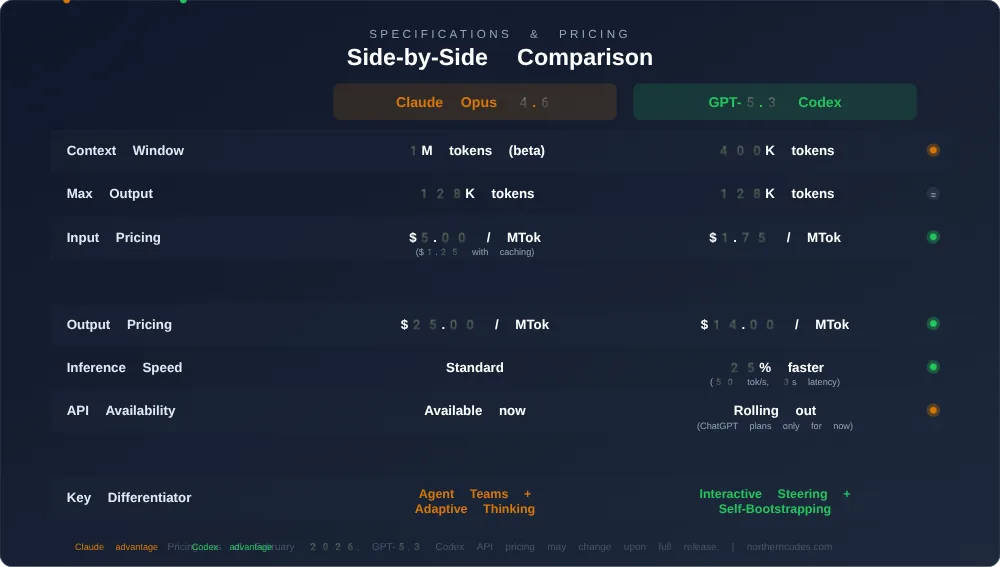
On paper, Codex is significantly cheaper per token - $1.75 input versus Claude's $5.00. But there's a catch: Claude's prompt caching brings the effective input cost down to $1.25 per million tokens for repeated contexts, which is actually cheaper than Codex for iterative workflows.
Then there's the context window difference. Claude offers 1 million tokens (in beta) versus Codex's 400,000. If you're working with large codebases, Claude can hold 2.5 times more context in a single session.
And there's the availability question. As of writing, Codex API access isn't fully rolled out. It's available through paid ChatGPT plans and the Codex interface, but if you need API access today for production use, Claude is the only option of the two.
Which One Should You Actually Use?
After spending time with both, here's our honest recommendation:
Choose Claude Opus 4.6 if:
You're working with large codebases that benefit from the 1M context window. Reasoning quality matters more than raw speed. You need reliable API access right now. Safety and alignment are organisational requirements. Or you want visible reasoning traces for debugging.
Choose GPT-5.3 Codex if:
Speed is your primary concern. You're building terminal-heavy automation workflows. Interactive steering fits your development style. Budget per-token cost is a deciding factor. Or you can wait for full API availability.
Or better yet, use both
Seriously. The models have different strengths, and the smartest teams we work with are routing different tasks to different models based on what each excels at. Complex reasoning task? Send it to Claude. Quick iteration loop? Route it to Codex. Multi-model strategies aren't just hedging - they're genuinely optimal.
FAQ: Claude Opus 4.6 vs GPT-5.3 Codex
Q: Which model is better at coding?
It depends on the task. Claude excels at code review, debugging, and working with large codebases. Codex is faster at terminal automation and iterative development loops.
Q: Can I use both models in the same project?
Absolutely. Many teams route different types of tasks to different models. APIs make this straightforward to implement.
Q: Which is more affordable?
Codex has lower per-token prices, but Claude's prompt caching can make it cheaper for repeated contexts. Total cost depends heavily on your usage patterns.
Q: Is the 1M context window on Claude reliable?
It's currently in beta with premium pricing above 200K tokens, but early reports show substantially better long-context performance than competitors. Claude scores 76% accuracy on the MRCR v2 test versus Sonnet 4.5's 18.5%.
Q: When will GPT-5.3 Codex API be fully available?
OpenAI says 'coming weeks' but hasn't given a specific date as of February 2026.
The Bottom Line
We're living in a genuinely remarkable moment for AI-assisted development. Two of the most capable coding models ever built launched within 24 hours of each other, and both are meaningfully better than anything available even six months ago.
The 'which one is best' debate misses the point. The real question is: how do you integrate these tools into your workflow to get tangible results?
That's where we come in. Whether you're looking to automate coding workflows, build AI-powered internal tools, or simply figure out which model fits your needs, we can help you cut through the noise and get straight to value. Get in touch to discuss how AI can work for your business.
Sources:
Anthropic - Introducing Claude Opus 4.6 | OpenAI - Introducing GPT-5.3-Codex | DigitalApplied - Complete Comparison | eesel.ai - GPT-5.3 Codex Review